

What A Belt Laminator Can Do For Your Business
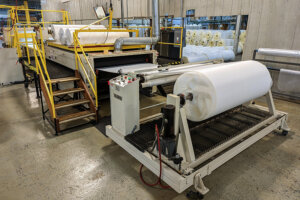 It’s one thing to need lamination services—it’s another to know exactly how to handle them. That’s what Conversion Technologies International is for! We’re here to walk you through the basics of what a belt laminator does—as well as its alternatives. And from there? We’ll introduce you to exactly what a contract manufacturer can do for your business.
What is the best laminator to buy?
Before diving into which laminator is the best to buy, take inventory of your project. What is your goal? How many items are you producing? How complex are your designs, and what are your main priorities? While you’ll find multiple options in terms of industrial laminators, finding the right laminator machine for your project can be a little trickier. Familiarize yourself with the main laminator types on the market, including:
—Pouch laminators. Most often, you’ll see these laminators in a small office, school, or home setting. They’re not made for large scale use. They include two pouches, one for the substrate product (usually paper) and the other for laminate solution. We use heat and pressure to seal these layers together, making the process fairly simple. You could consider these “a beginner’s laminator machine”.
—Roll laminators. These laminators process laminating film. It’s fed through the machine to laminate documents. Because they work with layers of a variety of thickness levels, they work for a variety of projects. We’ll more frequently use these machines for large scale projects.
—Belt laminators. This machine involves feeding the product through a belt system. During this process, it moves through different heating and cooling zones. These zones create a temperature-based pressure that activates the material’s adhesive qualities. The final product is perfectly laminated. Certain laminations are what we call “thermal laminations”, and that quality allows for enhanced adhesion. This covers not only film laminations, but rolled textiles, foams, foils, and web adhesives.
—Hot and cold laminators. Cold laminators use extra pressure—in lieu of heat—to lock in layers. This works for heat-sensitive products. Alternatively, hot laminators use both heat and pressure to create the final product.
As you can see, your options are manifold—you just need to select what fits your project.
Is buying a belt laminator machine worth it?
Buying a belt laminator machine may be tempting, but it’s not always necessary, and can be more trouble than it’s worth. If you don’t need consistent lamination services, you shouldn’t invest in a belt laminator. However, even if you do require more long-term services, buying isn’t your only option. You can also work with a contract manufacturer.
Contract manufacturing enables you to engage the services of an expert, who handles production for you. You agree to a set of terms ahead of time, and from there it’s up to the manufacturer. This allows you to avoid the expense and time involved in not only acquiring equipment, but suitable facilities.
Furthermore, neither you nor your employees need to learn how to use laminator machines with this system. The contract manufacturer already has experts on hand. This further reduces the need for trial and error. You’ll get your product faster, without the inconsistencies that can come when you experiment with handling processes like lamination on your own. And in the end, working with these third parties can be more cost-efficient.
Furthermore, you access a greater variety of techniques and machines than you might be able to afford on your own. Need a large format laminator for one project and a smaller laminator for the other? You might be better off outsourcing. A manufacturer like CTI has varieties of equipment on hand, which allow you to handle multiple tasks in one place.
Where can I get large laminating services?
As we hinted above—you can work with CTI! Generally speaking, you can expect large laminating services among our repertoire. A larger laminator allows you to process larger products. While it’s not uncommon for clients to require a mass amount of smaller products, an industrial laminator often addresses larger products. This is why it’s such a great idea to outsource.
Fortunately, CTI has plenty of experience with lamination in particular—in fact, we’re one of the industry leaders in this space. Although we work within many fields, we’ll highlight a recent automotive client. This client needed custom laminating services (as well as compressing)—with 1″ non-woven material by 80%. We had to laminate the material to aluminum and sheet it.
While previous experiences with other companies left the client skeptical as to whether or not we could fulfill this request, the team at CTI knew it was attainable. It required careful analysis, which resulted in us meeting a massive number of 400,000 units per year. We did it in record time, too! The parts ranged from 20″ to 48″ in width and 30″ to 60″ in length—no small feat.
We’re able to execute tasks like these because we customize your experience. It’s not up to you to fit our standards; it’s up to us to get the job done to yours. No matter what the challenge, we’re ready to take a look and ascertain a plan of attack.
Get the Ball Rolling Today!
Now that you know more about the CTI experience and how we address clients’ needs, we invite you to explore further with a consultation. Give us a call at 419-924-5566 or contact us here for more information. We’ll assess your project and determine the next steps from there!
- << < Previous Post
- 1
- 2
- ...
- 26
- ...
- 304
- 305 Next Post > >>